

 GP Services
 Allied Health Services
  Mental Health Services
  GP Consultation
  eScript & Prescription
  Online Medical Certificates
  Specialist Referral Request
  Pathology Referral Request
  Radiology Referral Request


 Physiotherapy
  Dietetics
  Telepsychiatry & Online ADHD Psychiatrists
  Online Psychologists
  What We Offer
  Telehealth Services
  Health Conditions


 Certificate Validity
  Corporate Health Services
  Online Doctor Consultation Melbourne
  Online Doctor Consultation in Adelaide
  Online GP Consultation Sydney
  Telehealth Consultation in Perth
  Telehealth GP Appointment for Brisbane Residents
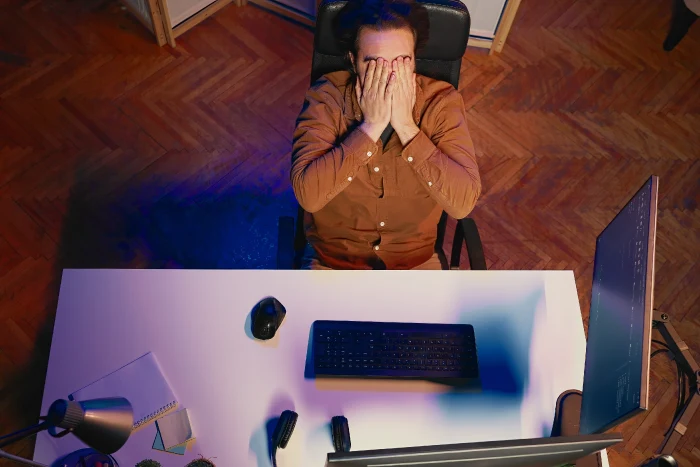
 A couple of years ago, people used to complain most about traffic or about the office air conditioning not working. Now, it’s a whole different story. I’ve been observing many workers discussing how they work from home, yet they feel as if they live at their workplaces, as if they are “living at work”.
Burnout has become a commonly discussed issue in remote work settings and is often associated with physical and mental strain.
Working from home means you have a work-life balance that doesn’t include a commute, but you can even fit that laundry between your tasks, for instance. Conversely, we have become so accustomed to mixing our homes and workplaces that it has become almost impossible to draw a boundary between them. If your workspace is the dining table, only a very few people would know how to detach and genuinely “switch off”.
If you work remotely, this article may be helpful, as it discusses burnout in remote work environments. I will explain how to recognise this condition, bounce back, and set boundaries. Don’t forget that your doctor is just a phone call away!
Recognising the Signs of Burnout in Remote Work
Burnout is not a mood swing or a temporary cooling-down time. It is often described as a state of emotional, physical, and psychological exhaustion linked to ongoing stress. Working remotely may contribute to ongoing stress for some people, as there is no one to “tell you that you look tired” and, more so, to advise you to take it easy.
What to Look For
It is sometimes difficult to recognise that you are already tired when, on the one hand, you are exhausted, miserable, and frustrated. But if I may speak based on my patient experiences, you may notice some of the following experiences:
- Mental Fatigue: You feel emotionally used up, feel like you can’t take in any more stress and are tired at the thought of even doing the most minor tasks.
- Cynicism: You’ve become more negative about work or lost interest in your colleagues. You could find yourself ignoring Slack messages or getting annoyed when it’s time for a Zoom call.
- Physical Symptoms: Some people report headaches or difficulty sleeping during periods of prolonged stress. At the same time, coffee will no longer be the magical elixir that replenishes your energy.
Noticing Signs of Burnout should not be interpreted as a weakness, but simply as you being too stressed to sustain the lifestyle you have been following.
Work Life Balance Matters
Working from home is marketed as the ultimate solution to the enduring struggle to achieve work-life balance, but in most cases, it is a misconception. Many people have a poorer work-life balance now than before. Although we don’t have to be physically at work or at home, we often find ourselves responding to emails at night or early in the morning.
Take Back Your Day
We certainly do not intend for you to believe that isolating work from private life could be done without any effort. One needs to consciously decide to practice the following activities so they can disengage, ultimately, even if it is for a moment, from work and, thus, reduce ongoing stress and strain:
- Commute the Fake Way: There should be a transition from home to work and from work to home. You may do a short walk around the neighbourhood, listen to your favourite podcast or change your outfit. Doing so will send a clear message to your brain that the work is over.
- Unwavering Boundaries: Later in the evening, turn off your phone. Today at 8 pm, if you do not accept a call from the “office”, you should obviously not be expected to reply to a Slack message at 8 pm.
You’d be surprised, really, how few things you need to do and what little changes in your routine alone could help you in setting healthy boundaries.
How to Talk to Your GP About Burnout
Asking for professional help with your mental health and talking to a doctor about stress might seem like a huge step to take. Most people who claim they cannot bother the doctor because they are not “sick enough” for a doctor’s visit. Your mental wellbeing deserves the same level of attention as your physical wellbeing.
How to get the most out of your visit?
Here are a few suggestions that you may use to prepare for a telehealth or face-to-face appointment:
- Long Consult: If you need more time to discuss your problem, you can book a 30-minute appointment instead of the usual 15-minute appointment. Mental health concerns can be complex and require more than just a few minutes to be appropriately addressed.
- Be Honest: Remember that it is essential to explain what is actually happening in as much detail as possible. It is perfectly fine if your first sentence is: “I’m stressed”, but it will be more helpful to say, “I keep crying before going to work,” or “I cannot sleep”.
- Mental Health Treatment Plan (MHTP): A GP can discuss the potential for a Mental Health Treatment Plan (MHTP), which may allow access to eligible Medicare-subsidised mental health services.
If you’re feeling overwhelmed, consider discussing your symptoms with a GP through telehealth, who can guide you on potential next steps.
Crafting A Me Time Space For Yourself at Home
One’s mood is closely related to the environment. So, if you are working in a place that contains all the stuff, darkness, etc., that your mind is full of at the moment, then it is no wonder that you cannot expect yourself to be in a good mood.
Ergonomics and Atmosphere
- Light Matters: Sitting on the sunlit side of the room can provide Vitamin D and a well-being boost. So, place your desk near a window.
- Divide the Areas: When you don’t have an office, consider restoring order to your workstation before dinner and leaving the day behind. The three magic words: “Out of sight, out of mind” are based on psychological findings.
- Feeling Good in Your Work Clothes: We remember how important it is to have a chair that supports your back, and to keep your screen at eye level to avoid unnecessary strain.
For more information and tips on workspace optimisation, please refer to our guide, Healthy Home Workspaces.
The Importance of Breaks in Overcoming Mental Fatigue
When you are working, you usually take breaks unconsciously: you go to the printer, chat with people in the kitchen or get a coffee. But at home, we can sit in front of the screen for several straight hours.
The “Micro Break”: an underestimated power trigger
The human brain is not a machine but rather a living organism. Not surprisingly, it also requires sure rest and recharging.
- 50/10 Rule: Work with sustained concentration on your tasks for 50 minutes, then take a complete 10-minute break. I.e., not just moving your fingers on the keyboard! Go outside, stretch or pet a dog.
- Lunch Must Be Sacred: Never eat at your desk. You shall take a short walk or any other activity that is not work-related. Many people find that stepping away from work helps them feel mentally refreshed. You will return to work with a completely different brain.
Visit the “Taking Breaks for Well-being” page for a deeper learning of the importance of breaks.
The Role of Telehealth in Workplace Stress Management
After a heavy workday, who else would want to get into the car again and go to a doctor’s waiting room? Telehealth can be a convenient option for some people.
Support that is Always There
Telehealth has many advantages, and one of the main benefits is that it allows you to speak with your physician wherever you are without hindrance.
- Ongoing Care: Your progress can be recorded at any time, and follow-up discussions can be arranged as needed through regular video, phone, or email check-ins.
- It can be quite personal to go to a Doctor to talk about workplace stress. If you are more comfortable with telehealth at Home, it can provide a sense of intimacy.
- If appropriate, a GP may discuss referral options to a psychologist or counsellor the next visit will take care of itself, so no worries required.
You can book a Telehealth session to discuss your symptoms with a GP, who may guide appropriate support options.
Your Health Conversations: Private Secure
Prime Medic is very aware of the fact that mental incidents are very sensitive and personal in nature. Hence, we strictly abide by the privacy and security regulations of the Office of the Australian Information Commissioner (OAIC). Texts are encrypted, and medical files are stored on Servers in Australia, respectively. You can also rely on us for your utmost privacy and safety.
Summary of the main points
- Spot the Signs: Fatigue, cynicism, and ‘mental cloud’ state are the main signs to watch out for when assessing burnout.
- Learn to say No: You didn’t have a real commute? Then invent one and, at the same time, turn off notifications to better separate the two worlds.
- Surround Yourself: The disorder and messiness of your workspace can reflect your mind.
- Talk: Make time for a longer consultation and discuss a Mental Health Treatment Plan so you can be on the same page with your GP.
- Use Telehealth: doctor visits are among the last things you consider when you are stressed. But in your own home via telehealth, it is stress-free, fast, and very easy.
Disclaimer: This article contains only educational and informational material and should not be interpreted as professional advice, diagnosis, or treatment. You should always consult with a General Practitioner or any other qualified healthcare professional before making decisions about your health. If you are experiencing a mental health crisis, please call Lifeline on 13 11 14 or 000 immediately.
References: