

 GP Services
 Allied Health Services
  Mental Health Services
  General Consultation
  eScript & Prescription
  Online Medical Certificates
  Specialist Referral Request
  Pathology Referral Request
  Radiology Referral Request


 Physiotherapy
  Dietetics
  Telepsychiatry & Online ADHD Psychiatrists
  Online Psychologists
  What We Offer
  Telehealth Services
  Health Conditions


 Certificate Validity
  Corporate Health Services
  Online Doctor Consultation Melbourne
  Online Doctor Consultation in Adelaide
  Online GP Consultation Sydney
  Telehealth Consultation in Perth
  Telehealth GP Appointment for Brisbane Residents
 Key Takeaways
- Prepare for pregnancy: a pre-pregnancy checkup with your family doctor will help you identify health issues that could pose risks later.
- Become familiar with your body: ovulation should be used to determine the best time to have intercourse to get pregnant naturally.
- Style of life matters: diet, body weight, smoking and drinking influence not only female fertility but also male fertility.
- Don’t hesitate: if you are 35 or older and/or have irregular cycles, you should consider seeking professional advice immediately.
- There are many ways to become a parent. As a parent, you can choose from several paths: from family planning to IVF or egg freezing.
Choosing whether to have children and when to have them are the most life-changing decisions one can make. Often, a person’s first step in reproductive planning is a baby-making trial, or simply curiosity about their own body; any of these is a starting point.
As a GP, I frequently see how patients who want to understand more about their reproductive health get overwhelmed by the vast amount of information (and misinformation) that is available online. There are many more dimensions to reproductive health besides just “trying or not trying”. It’s about knowing your options, getting your body in top shape, and picking the choices that fit your lifestyle after being adequately informed.
If you are new to reproductive planning in Australia, this booklet should help. It will accompany you throughout the journey, from discovering your inner self to recognising when professional intervention is needed.
Getting to Know Yourself: Understanding Your Reproductive Health and Family Planning Ambitions
Choosing when to have children was initially a conversation between a couple in love, and the most significant issue was whether to have children at all. You also consider your current health, lifestyle, and plans.
There’s no perfect time to have children. But a prepared mind has many other exciting things to accomplish. We should never forget that the health of the mother before conception plays an important role in pregnancy and early development and, of course, happy parents.
Here is a brief list of questions that you can use to guide your decision:
- Would I like to have children? If yes, how many and when?
- In what way does my age affect my fertility?
- Should I undergo genetic testing if there is a history of genetic disorders in my family?
- Am I currently on any contraception? How can I discontinue it?
Being in control now will prevent worries later. For example, being vaccinated regularly and managing existing health conditions, such as diabetes or blood pressure, is an important part of pre-pregnancy planning. If your stage of change is long-term, you may always carry the over 40 guide with you.
Knowing the Fertility Cycle: How the Knowledge of Your Cycle Can Help You in Family Planning
Most people receive the correct explanation of reproductive biology for the first time when they are about to have children; until then, it may appear like a puzzling jigsaw with only one or two pieces out of place. Understanding the menstrual cycle is the first step toward a better understanding of the reproductive system.
Menstruation and Ovulation
Although the average menstrual cycle lasts 28 days, it may range from 21 to 35 days. Ovulation, the primary determinant of conception probability, is when one single egg is released from the ovary.
- Windows of Fertility: During any of the five days before ovulation, as well as on ovulation day, intercourse can increase your chances of conception. Sperm from a male can survive for up to five days within a female; therefore, when the egg is released, the sperm will be ready to fertilise.
- Tracking: To determine your fertility window, you can utilise ovulation predictor kits (urine tests), apps, or calendars.
On the other hand, one should bear in mind that, although these techniques are constructive, they can also make one anxious. Come to think of it, in the case that your menstruation is very irregular, it is almost impossible to work out when you release the egg, and that is why you have to see your doctor.
Different Ways to Achieve Pregnancy: Fertility Options: Natural Versus Assisted
The phrase “fertility options” is a term that describes the different pathways one can take to achieve pregnancy.
Natural Conception
Under normal circumstances, if two healthy adults have regular unprotected intercourse (every 2 3 days) throughout the month, many couples may conceive within 12 months. This method, known as “natural,” relies on the statistical probability of sperm and egg meeting during the fertile window.
Assisted Reproductive Technology (ART)
Sometimes, one needs to help ‘Mother Nature’ along the way. Australia has a well-established network of services, making assisted reproduction a reality for many.
- Ovulation Induction: stress may be associated with changes in menstrual regularity or sperm parameters in some people. i.e., the release of an egg. This is mainly for ladies who do not ovulate or do so irregularly.
- Intrauterine Insemination (IUI): Sperm that is washed and concentrated is placed directly into the woman’s uterus at ovulation.
- In Vitro Fertilisation (IVF): Ovarian stimulation is followed by egg retrieval. Subsequently, eggs are fertilised in the laboratory with sperm. Embryos are then returned to the uterus.
Other reasons besides infertility can make a person eligible for such treatments to enhance fertility. A single individual or a same sex couple is an example.
Fertility Preservation: Options for Parenthood at a Later Stage
One thing about life is that it can always surprise us. For instance, you may have children among your goals, but you haven’t yet met the right partner. Or you may be a career-oriented person or a free spirit who prioritises travel. Medically speaking, there are cases when treatment (for example, chemotherapy) adversely affects fertility.
Fertility preservation is the technology of storing eggs, sperm, or reproductive material so that one can have biological children later.
Egg Freezing
Hormones are used for ovarian stimulation in such a way as to have several eggs produced. Then, eggs are retrieved and frozen (cryopreservation). If you decide to conceive in the future, these eggs can be thawed and fertilised using IVF. Typically, the chances of success with frozen eggs are higher when they are frozen at a younger age (usually before 35), as egg quality declines with age.
Freezing Sperm
Collection of sperm and freezing it is a simple, non-invasive procedure, and men who are going to have medical treatment that will affect sperm quality are usually recommended to do it.
For those weighing their fertility preservation options, a telehealth appointment will offer a platform for such initial discussion and referrals to fertility specialists.
How Your Lifestyle Choices Affect Your Reproductive Health
Your everyday routine has an unexpected effect on your reproductive health. It is valid for both men and women after all, “it takes two to tango”, right? Here are the significant points:
- A person has to be really very thin or overweight before the hormones go haywire, and ovulation in women and sperm production in men are affected.
- Smoking damages both eggs and sperm since it results in faster egg loss and sperm DNA damage. At the same time, the consumption of alcohol should be entirely stopped or very strictly controlled in the period leading up to pregnancy.
- The neuroendocrine system can be easily disrupted by stress, leading to anovulatory cycles or low sperm production.
- Food: nutritious, healthy foods are those rich in antioxidants, healthy fats, and folate. There is a national recommendation in Australia that women who are about to get pregnant should take folic acid and iodine supplements so that the risk of their baby being born with a congenital disability is reduced.
To further explore how drinking water supports healthy skin and body systems (including a healthy cervix), see our article, Skin Hydration.
Visiting Your GP for Reproductive Planning: Tips
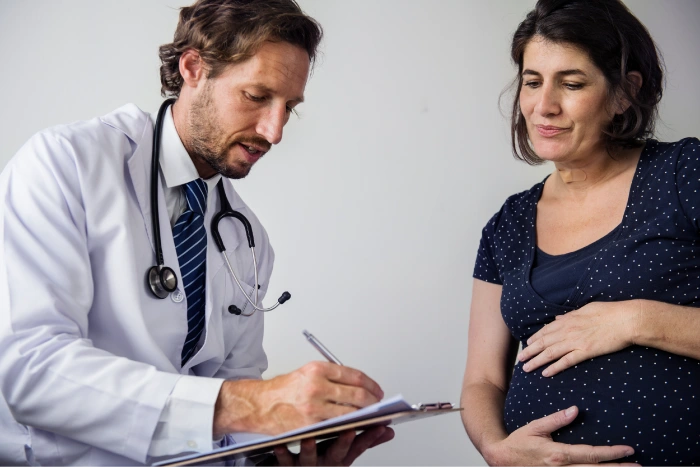
Appointments for a pre-conception exam are among the most innovative moves that anyone can make. You don’t need to be pregnant to visit us; in fact, we recommend you come before you begin this journey.
Here is a very brief outline of what to ask about:
- Medical History: Ensure there are no hidden details regarding your past surgeries, STIs, or chronic illnesses.
- Medications: some medications may not be recommended during pregnancy. Your doctor may want to change you to something safer.
- Vaccinations: It is a must to find out whether or not you are immune to Rubella and Chickenpox, as these infections can have implications during pregnancy.
- Genetic Carrier Screening: We can now offer tests to determine whether you and your partner are carriers of genes that cause diseases such as Cystic Fibrosis and Spinal Muscular Atrophy, even without a family history of these conditions.
Guidance at What Moment(s) Should We Consider Professional Help in Making a Family Plan and Having Children?
It is a very frequently asked question: “How long shall we keep on trying before we go see a doctor”? There are some general rules of thumb to follow in Australia:
- If you are under 35 and have had once a month, unprotected sexual intercourse for a year without achieving pregnancy, then it is time to see a doctor.
- If you are above 35, only 6 months of trying will require you to visit a fertility specialist.
- If you suffer from known issues such as irregular cycles, PCOS, endometriosis, or if you have had testicular trauma, then you should not delay the visit to the doctor for a minute. In fact, do see the doctor immediately.
It is worth remembering that the inability to get pregnant after a whole year of trying is a medical condition. It is not a failure, and it affects approximately one in six couples in Australia.P.S. As you find your way through these profoundly personal matters, always remember that your confidentiality protections are kept intact with more information on Data Privacy.
References: