

 GP Services
 Allied Health Services
  Mental Health Services
  GP Consultation
  eScript & Prescription
  Online Medical Certificates
  Specialist Referral Request
  Pathology Referral Request
  Radiology Referral Request


 Physiotherapy
  Dietetics
  Telepsychiatry & Online ADHD Psychiatrists
  Online Psychologists
  What We Offer
  Telehealth Services
  Health Conditions


 Certificate Validity
  Corporate Health Services
  Online Doctor Consultation Melbourne
  Online Doctor Consultation in Adelaide
  Online GP Consultation Sydney
  Telehealth Consultation in Perth
  Telehealth GP Appointment for Brisbane Residents
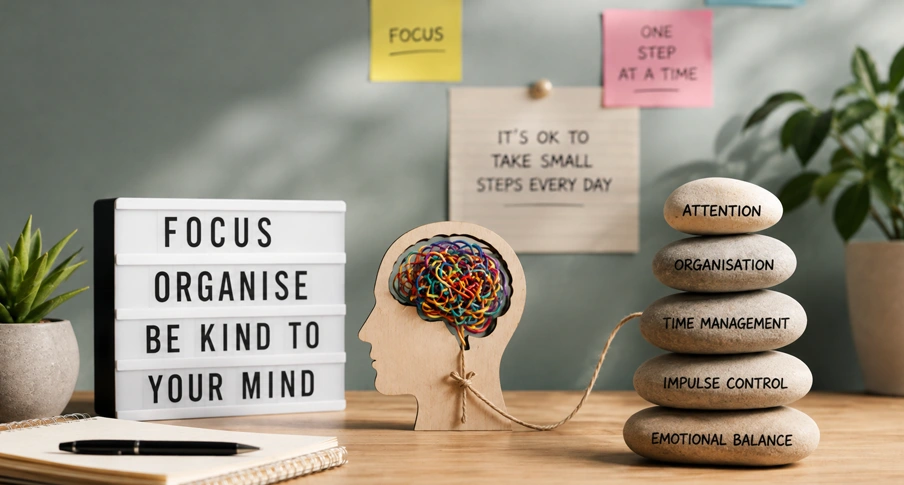
 ADHD is a neurodevelopmental disorder that involves deficits in attention, organisation, impulse control, and activity regulation. Although ADHD symptoms develop in childhood, many sufferers continue to experience symptoms at later ages. Others may not be diagnosed until years later, when the disorder is no longer obvious to others.
ADHD symptoms can be quite different in different individuals. Some people are more affected by attention problems, while others find their hyperactivity or impulsiveness more problematic. Many people experience both. If you can identify with some of the symptoms, you then have a vital first step to getting the right assessment and support.
What Is ADHD?
ADHD (Attention Deficit Hyperactivity Disorder) is a disorder impacting the brain’s executive functioning. Executive functioning relates to the cognitive ability to organise, plan, remember facts, manage time, and control one’s behaviour. Such functions enable individuals to perform an array of daily activities, concentrate, and adapt to situations.
Everyone can be momentarily inattentive or forgetful. These are not guidelines for what would be considered abnormal or ADHD symptoms, as individuals who truly have the disorder tend to exhibit these behaviours more frequently, in all domains, and have a real impact on everyday life.
We need to be clear that attention deficit disorder is not due to ignorance, neglectful parenting, lack of intelligence, or laziness. It is a valid medical condition.
Common ADHD Symptoms
The appropriate presentation of ADHD symptoms is usually divided into three groups: inattentiveness, impulsivity, and hyperactivity. The presentation of these in individuals can be subjective to a certain degree, depending on their age and situation.
1. Inattention
Inattentive individuals may find it hard to concentrate on what they are saying, working, or doing at school or work. They are easily confused or distracted by their environment, and they forget things, miss appointments, lose things, or have trouble concentrating on certain tasks.
2. Hyperactivity
Hyperactivity is usually more associated with children, although it is also diagnosed in adults, with a slightly different presentation. The most common presentation seen in a child is that of the child not being able to sit still, running or climbing when inappropriate, or simply appearing to be constantly moving.
The adult will be more fidgety, less comfortable sitting still for long periods of time, talk more than normal, or fidget to keep busy all day.
3. Impulsivity
Impulsiveness is acting before thinking of the long-term effects. Impulsiveness may involve making Irrelevant and inappropriate comments, speaking rapidly, rushing and hurrying to the detriment of oneself, having problems with delaying response, and having problems waiting while taking turns.
Adult ADHD Symptoms
Certain adults have contributed to the adult ADHD symptoms, even individuals who seem to have escaped hyperactivity in their childhood. Yet the concerns with focus, organisation, and time-keeping continue to persist.
Adults with ADHD symptoms might have difficulties working things out in sequential order, remembering appointments or deadlines, or completing a task. Everyday requirements, which for most people may be perceived as just a slight annoyance, may prove impossible (e.g., managing a household, paying bills, answering e-mails).
If you have been experiencing these symptoms for many years and they are still disrupting your daily life, then your doctor will probably send you for an assessment for Adult ADHD.
ADHD Symptoms in Women
With the rise in awareness, symptoms in females are being diagnosed more and more, although most are not diagnosed until adulthood. Girls tend to be more attentive and less hyperactive than boys, and so it isn’t as easy to diagnose them.
By way of illustration, a woman with ADHD symptoms might seem very well organised and efficient in a social setting, but when she is at home or in private, she is fatigued trying to keep all her commitments in her head and remembering everything.
Since the foregoing may be perceived differently from person to person or mistaken for other similar pressures or conditions of life, a clinical assessment and not a list of symptoms can diagnose ADHD in women.
Under What Circumstances Would You Seek an ADHD Evaluation?
Occasional carelessness or trouble paying attention can happen and not mean you are showing ADHD symptoms. Nevertheless, it may be worth asking for a diagnosis if the symptoms
- Have been around since you were a kid.
- Happens across more than one location, e.g., at home, work, or school.
- Interfere constantly with your work, studies, relationships, or your daily routine.
- Continue to impact your life or be a source of frustration.
An assessment for ADHD can also distinguish whether or not your issues are caused by this condition or indicative of something else that may need a different way of examining and proceeding.
What Does an Adult ADHD Assessment Involve?
An adult diagnosis of ADHD should only be made by an appropriately qualified health care professional, on completion of an assessment.
The assessment may involve an in‐depth interview about presenting problems, childhood and family history, general medical history and the impact on daily functioning.
There is not one laboratory test or scan of the brain that diagnoses someone with ADHD. Instead, diagnosis is made using established clinical criteria and a detailed history and assessment.
ADHD Treatment and Support
Management of ADHD is tailored according to age, severity of symptoms, and the individual’s needs. A doctor will usually suggest a suitable treatment plan.
ADHD therapy
ADHD therapy can teach approaches to managing attention, organisation, and emotional self-control and other day-to-day problems. It can also offer tips to improve routines and to handle situations that involve sustained attention.
ADHD coach
An ADHD coach is another resource. Coaching is goal-oriented and practical, helping with managing your time better, establishing effective routines, developing organisational skills and remaining accountable. Coaching would typically be supplementary to the health care received from a doctor or therapist.
Medication
Medication itself is an option that can be considered by some individuals as part of an overall treatment plan. Prescriptions should be agreed upon before administration by an appropriately qualified health care provider.
Living Well With ADHD
Despite the long-term consequences of ADHD, a lot of people with this can learn to adapt in such a way that they are actually capable not only of doing their day-to-day activities but also of achieving their goals.
Simple habits can make a meaningful difference, including:
- Use a calendar, reminders, or planning applications to be completely organised.
- Splitting a big task into smaller, more sensible tasks.
- Forming good daily routines.
- Eliminating distractions when working or studying.
- Ensure you allow time each day for sleep, exercise, and good health.
Finding strategies you can incorporate into your life regularly will generally increase your self-confidence and help you to cope with life more easily over time.
Conclusion
ADHD symptoms can include difficulties with attention, organisation, impulse control, and everyday functioning from childhood through to adulthood. As each individual’s symptoms may vary, the ability to identify ongoing symptoms can often mark the initial step in determining whether such concerns, in relation to the inability to manage everyday occurrences, may have a foundation.
If it is resulting in a high level of interference in these areas, getting a professional diagnosis can help to determine the potential cause and access support. Early diagnosis and tailored approaches can help individuals get to know their strengths, manage difficulties, and optimise their quality of life.
Frequently Asked Questions
At what age does ADHD start to show?
Signs and symptoms of ADHD generally are evident before the age of 12, but in some children may be apparent during the preschool years. The age at which symptoms become obvious varies from child to child.
What are the first signs of ADHD?
Signs of early symptoms may include being unable to concentrate for long, experiencing frequent lapses of memory, hypersensitivity to movement, a tendency to act impulsively, or being unable to carry out simple instructions.
How to get tested for ADHD?
The assessment for ADHD is conducted by a professional who will look at the symptomatology, its severity and duration, as well as the history of the individual and childhood, and how the symptoms interfere with their life.
What is the best treatment for ADHD?
There isn’t one best treatment for all. Management may involve education, behavioural treatment for the symptoms of ADHD, coaching, and, if necessary, medication prescribed by a qualified doctor.