

 GP Services
 Allied Health Services
  Mental Health Services
  GP Consultation
  eScript & Prescription
  Online Medical Certificates
  Specialist Referral Request
  Pathology Referral Request
  Radiology Referral Request


 Physiotherapy
  Dietetics
  Telepsychiatry & Online ADHD Psychiatrists
  Online Psychologists
  What We Offer
  Telehealth Services
  Health Conditions


 Certificate Validity
  Corporate Health Services
  Online Doctor Consultation Melbourne
  Online Doctor Consultation in Adelaide
  Online GP Consultation Sydney
  Telehealth Consultation in Perth
  Telehealth GP Appointment for Brisbane Residents
 Key Takeaways
- A GP COPD & Chronic Disease Management Plan supports coordination between healthcare providers.
- Telehealth consultations may assist with administrative updates to care plans.
- Digital referrals and reporting can streamline communication between specialists and GPs.
- Patients retain control over access to their care plan through privacy settings.
- Administrative documentation can support workplace, travel, and specialist coordination needs.
Healthcare can involve multiple appointments, prescriptions, and diagnostic processes; managing a long-term respiratory condition may require ongoing coordination and organisation. The GP Chronic Disease Management Plan (GPCCMP) is a structured document that supports care coordination for patients following a care path comprising multiple steps.
While your treating team focuses on clinical care, coordinating that care needs a high level of organisation. This guide explains how to make administrative tasks easier when you have a diagnosed breathing condition by keeping your documentation secure, informing your specialists, and keeping your personal records ready whenever you need them.
What is the GP Chronic Disease Management Plan (GPCCMP)?
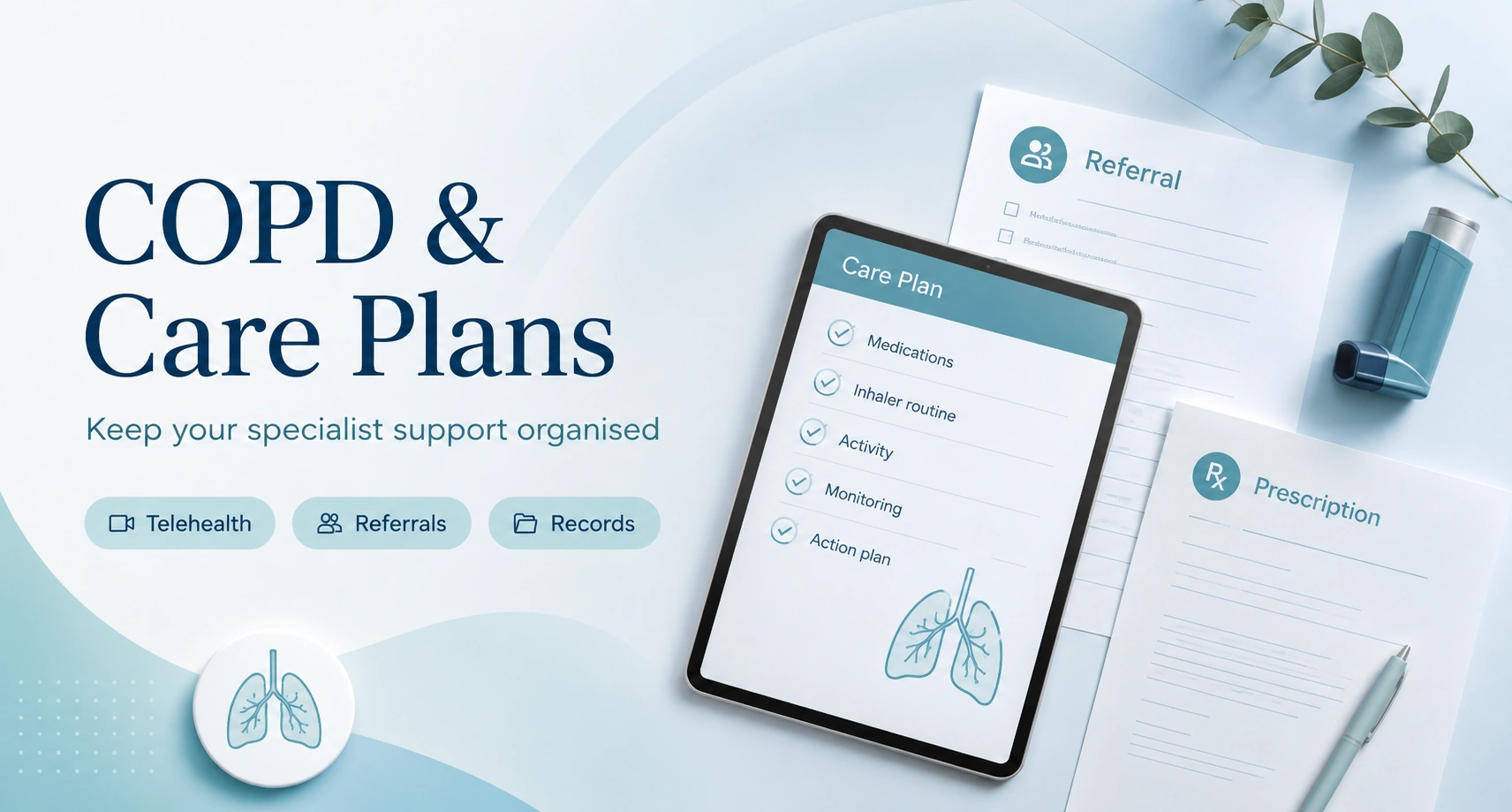
From an administrative perspective, a COPD or GPCCMP is a formal document that outlines your health care needs. It is not a treatment but rather a “master file” that aligns the actions of different healthcare team members.
Documentation Clarity
- The Master Plan: A GPCCMP designates your primary health providers. For a patient with a long-term respiratory condition, the team may include a GP, a respiratory specialist, and an exercise physiologist or a telehealth dietitian.
- Referral Paths: One major advantage is access to Medicare-subsidised allied health services. This involves precise paperwork, such as a pathology referral, which must be filed correctly to ensure benefits are claimed.
- Scheduled Reviews: To remain valid under Australian law, these plans must be reviewed every 3 to 6 months. These sessions are vital for updating your specialist care attendance certificates and pharmacy lists.
How Telehealth Facilitates Keeping Your Records Updated
For patients with breathing difficulties, travelling to a clinic just to update a form can be exhausting. Virtual care has significantly improved the efficiency of GP-CCMP coordinated care.
Remote Access and Messaging
- Digital Updates: If you change your address or add a new specialist, an online doctor consultation can verify your identity and update your master plan instantly.
- File Transfers: Secure messaging platforms enable your GP to receive reports from your specialist and immediately add them to your central care plan. Therefore, when you meet another provider, they can access the latest available information, subject to system updates and provider participation.
- Safe and Secure: All digital changes are made in accordance with Australian privacy legislation and applicable security standards, ensuring your personal health information is treated with the utmost care, as if it were a physical document stored in a locked cabinet.
Coordinating Specialist Appointments and Reports
The ‘Specialist-GP’ circuit is a common place for administrative blunders. These errors often delay care. One way to tailor your experience is through the GP Specialist Communication Streamlining. Streamlining this “circuit” is essential for effective long-term management of conditions.
Digital Communication Channels
- Electronic Referrals: Digital referrals are sent directly to a specialist’s secure portal, ensuring they aren’t lost in the mail. This is especially useful when requesting a new specialist referral or a repeat specialist referral.
- Centralised Reporting: Whenever a specialist sends a report to your GP, the report is transmitted to the GP through secure messaging systems for review. Thus, your care plan includes the latest specialist input, and you don’t have to act as a messenger between their offices.
- Administrative Support: At Prime Medic, administrative support may be provided to assist with document coordination between providers.
Keeping Your Personal Records Neat for Slick Conversations
Even though your GP and specialist will keep their own records, there is one person who is more important than they are in this case: you. Having your own ‘Health Folder’ can be a great relief during difficult moments.
Document Management Tips
- Digital Summaries: At every major review, get a Prescription Summary. You can save these in an electronic safe on your device.
- Organise Receipts and Reports: Consider creating a file for diagnostic test receipts (e.g., lung function tests) and specialist receipts. This will make your life easier when filing your taxes or claiming health benefits.
- Privacy Controls: You have the right to decide who sees your stored data. For instance, if some old reports are not relevant to your current care, you can selectively hide them from your My Health Record view.
Workplace or Travel Support Documentation
Having a chronic breathing condition means that sometimes you may not be able to attend medical appointments or have sudden flares that will be disruptive to your everyday routines. The right paperwork can help protect your rights at work and while travelling.
Work and Life Administrative Support
- Attendance Records: With frequent specialist visits, a telehealth consultation in Brisbane may result in an online medical certificate or attendance letter, if clinically appropriate, to accommodate your leave requests under Fair Work Australia law.
- Travel Letters: For those travelling with medical equipment or requiring additional time during transit, an administrative letter from your GP can be included in your care plan. This letter will serve as official identification for airlines or accommodation providers supporting your respiratory condition certificate requirements.
Feeling Prepared to Navigate Your Plan
A care plan should not be something one is passively subjected to; rather, it should be a product of one’s agency. Being informed about your administrative options can help you participate actively in your care planning.
Self-Advocacy in the Care Loop
- Be Inquisitive: You’ve got every right to ask your GP, “Who are the people on my current care plan?” or “When are we due for a review?”
- Take Control: If you notice that part of your administrative plan is not working (e.g., you have changed your specialist or your suburb), signal your online GP that you want to discuss it.
- Ask for Support: Navigating government systems such as PBS or Medicare can be challenging. Our team may assist in explaining documentation processes and administrative requirements where appropriate, allowing you to focus on the essentials.
You may wish to organise a telehealth GP appointment to discuss your current documentation, or you want to explore Specialist communication further. For more on coordinating chronic care, see our guide on GP-CCMP endocrine management.
Is a GPCCMP a must?
There’s no compulsion. It’s a voluntary administrative instrument to facilitate care coordination for individuals with chronic conditions. You may discontinue or close your plan at your own discretion.
Is it possible to have a care plan if I see a private specialist?
Yes, your GP can prepare a care plan that includes both public- and private-sector specialists. The plan individuals with chronic conditions. You may discontinue or close your plan at your own discretion.
How can I request an update to the plan?
You can schedule a telehealth consultation to talk about changes. Your GP will review your update and itself is a Medicare-regulated administrative document, irrespective of whether your specialists are private or public.
Who has access to my care plan?
Healthcare providers involved in your treatment may access the plan in accordance with applicable privacy laws and consent settings. You can limit access using your My Health Record settings.