

 Services
  GP Services
  General Consultation


 eScript & Prescription

 Online Medical Certificates


 Specialist Referral Request


 Pathology Referral Request
  Radiology Referral Request
  Allied Health Services
  Physiotherapy
  Dietetics
  Mental Health Services
  Telepsychiatry & Online ADHD Psychiatrists
  Online Psychologists
  Mental Health Plan
  What We Offer
  What We Offer
  Telehealth Services


 Health Conditions


 For Employers
  Certificate Validity
  Corporate Health Services
  Telehealth Coverage
  Online Doctor Consultation Melbourne
  Online Doctor Consultation in Adelaide
  Online GP Consultation Sydney
  Telehealth Consultation in Perth
  Telehealth GP Appointment for Brisbane Residents
Coughing up green phlegm can be alarming, especially when coupled with a feeling of heaviness in the chest. It can be alarming when phlegm seems to irritate the throat. Irritable coughing that seems persistent will have the person questioning the possibility of a chest infection or the potential need to start a course of antibiotics.
Many people will ask guiding questions. “Are the symptoms of my illness severe enough to start a course of antibiotics? Is my illness a common cold, bronchitis, or a sinus infection with drainage? Will my illness be better in a few days with the use of Mucinex and some TLC? Is my illness a slow cough and green phlegm infection? Is the slow cough and intermittent phlegm infection going to be better with medical intervention? Will the symptoms of my cough and the characteristics of my phlegm and mucus remain constant and persistent?”
It may be better with a doctor’s instruction, especially if the symptoms get worse or if the person is having difficulty breathing. It is most certainly better if the situation is an infection in which a normal traumatic cough, phlegm, and TLC, Mucinex, and antibiotics were ineffective. Please ask a doctor for medical instructions.
What Does Coughing Up Green Phlegm Mean?
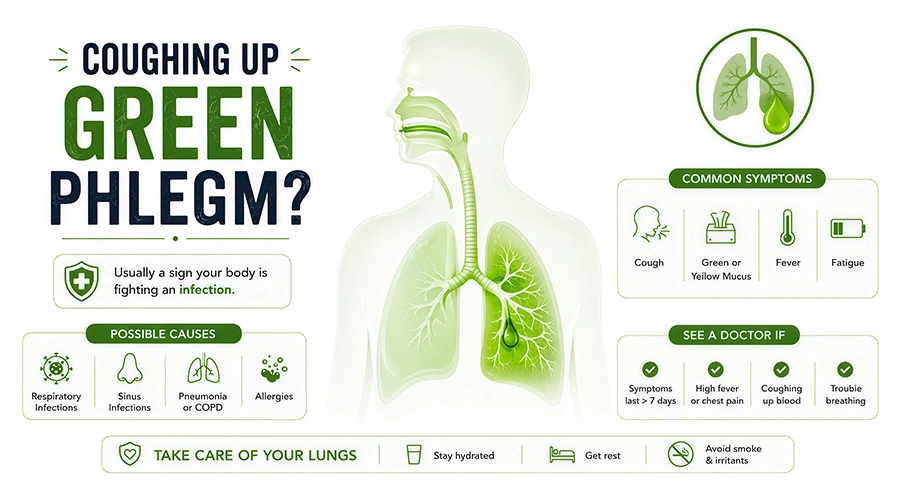
Green phlegm indicates that your body is dealing with an infection or some other inflammation or irritant that is affecting your body. It could be due to a viral or bacterial infection. It could also be due to an allergy or irritants in the air, like dust.
Green phlegm does not necessarily mean an infection is severe. In some cases, it may not even mean an infection is present
Green phlegm presents a predicament for many patients as well. It happens with a viral infection. It happens along with a cough that is green. Antibiotics do not work with viral infections. This means a physician will need to evaluate your health holistically to set the right infection control method.
Physicians will usually check on all of the following
- How long have you had a cough from your condition
- What is the cough like? How severe is the condition? Is it improving or worsening?
- Do you have any elevated temperature?
- Do you have difficulty breathing?
- What about the presence and intensity of the pain in your chest?
- What about the blood in your sputum?
- How old are you? What is your history when it comes to health?
- Do you have other conditions like Asthma, COPD, heart disease, or a compromised immune system?
Because green or any other color of phlegm, for that matter, presents a small condition, it can be a factor for almost all conditions.
Does The Presence Of Green Phlegm Mean That You Have A Chest Infection?
It is possible, but it is not for sure.
Symptoms of a chest infection can include a cough, febrile and/or chill-like symptoms, and the production of brown or green sputum with chest pain, along with increased respiratory rate. This would probably explain how sick Pool is. Better Health Victoria lists brown or green sputum along with fever, chest pain, and/or difficulty breathing as symptoms of a chest infection, along with general malaise.
Other people with a respiratory infection that is a lower or bronchial infection can also produce green or brown sputum, and that alone would not denote the presence of a bacterial infection.
You should monitor your symptoms. A mild cough that starts to improve can happen with time. However, if a cough, chest pain, or breathing symptoms persist or worsen, it would be best to see a doctor.
Common Causes of Coughing Up Green Phlegm
There are a few reasons you might find the presence of green phlegm to accompany your cough. Some can be less than serious, and some may require more significant evaluation.
1. URI / Influenza
A URI or similar infection can lead to a cough in conjunction with a sore throat, nasal congestion or discharge, and may also cause general malaise with muscle or generalized body symptoms. All of these combined can lead to a serious infection. As this infection progresses, the body produces more mucus, and the color can also change.
In the case of respiratory infections of this type, you can expect a change of mucus color from being clear initially to yellow or green. A part of this is your body’s immune response.
Still, if your CVI symptoms get worse or don’t improve at all, seek advice from a medical professional.
Presence Of Acute Bronchitis
Acute bronchitis comes as a result of larger airways of the lungs becoming irritated and inflamed. It may bring about a dry cough or a cough that brings up phlegm.
According to Healthdirect, bronchitis will bring about a cough with or without phlegm, and the cough may last for about two to three weeks if the bronchitis is acute.
Additional symptoms may include the following:
- Chest discomfort
- Shortness of breath
- Wheezing
- Head congestion or a runny nose
- Headache
- Tiredness
- Fever
- Body aches
Acute bronchitis is usually brought about through a viral infection; thus, the use of antibiotics is not necessarily important unless a medical doctor suspects a bacterial infection of a clinical indication of a bacterial infection.
Presence Of A Chest Infection
Chest infections may affect your airways or the larger sections of your lungs and may make you produce brownish or greenish phlegm. It also leads you to feel poorly, causes fever, chest pain, and makes it hard to breathe.
A chest infection is more serious for
- Older people
- Young children and babies
- Pregnant people
- People with asthma or COPD
- People with heart disease
- People with diabetes
- People with weakened immune systems
If you belong to these categories and find that you are truly producing green phlegm, it may be advisable to visit a doctor.
4. Sinus Drainage Or Post-Nasal Drip
Sometimes mucus is in the sinuses or drips back from the nasal passages into the throat, causing post-nasal drip.
Post-nasal drip has symptoms such as:
- Chronic throat clearing
- Nighttime cough
- Nasal obstruction or congestion
- Pharyngitis
- Halitosis
- Facial or forehead pressure
Coughing up green phlegm may indicate the presence of thin mucus from the upper air passages.
5. Asthma or Airway Irritation
Airways can be irritated by asthma, allergies, or smoke, dust, pollution, or fumes. These may include cough and appearances of mucus, wheezing, and chest tightness.
Inner airways can be irritated by asthma, allergies, or smoke or fumes. They may be associated with cough and appearances of mucus, wheezing, and feelings of tightness in the chest.
If you have asthma and your cough is different from what you consider your normal, when your breathing is worse, or you even need to use your reliever more often, you have it.
6. Smoking or Vaping
Airway and lung irritation and mucus production can be increased by both smoking and continuous smoking, or from cigars or continuous vaping. Chronic cough with phlegm is a serious condition. If chronic cough with phlegm is recent, worsening, or is accompanied by any of the following symptoms, breathlessness, chest pain, weight loss, or blood in your sputum, serious condition.
Does Coughing Up Green Phlegm Mean You Need Antibiotics?
The answer is no, but it is true. Coughing Up Green Phlegm is one of the most useful substances to collect because it is often necessary to obtain a clearer desired specificity and answer required in order to obtain a clearer and more direct answer to the nature of the infection. Coughing Up Green Phlegm does not specifically mean that you cough, you will cough, or you may cough more than the normal phlegm you obtain from the phlegm you collect. Like the infection, it can be classified into either a viral or a bacterial infection.
Healthdirect states it’s common to have concerns over a potentially serious illness with a productive cough. To seek a doctor’s consultation or other pharmacological intervention (antibiotics), it states that the condition should be watched if phlegm is bloody, green, or yellow.
A doctor may decide to use self-care or adopt a monitoring or testing plan, given the symptoms and the medical history.
Do not take a leftover prescription, nor self-medicate with a friend’s medical plan, nor more. Let what works for others be.
Green Phlegm With Fever Requires You To Visit A Doctor
Consider a doctor the following cases:
- Your cough worsens
- Your cough is persistent, lasting 2-3 weeks
- You are wheezing or feel chest tightness
- Your symptoms start to ameliorate and then worsen.
- Do you have any serious underlying conditions
- You are pregnant
- You are worried about a vulnerable individual
- You feel weak, dizzy, or drowsy
- You are coughing up blood.
These symptoms, especially with green mucus, warrant a doctor’s visit. When to Recognize When to Get Emergency Medical Attention
Some Symptoms That May Arise Are Serious And Require Medical Help
If you or another person experiences one of the following symptoms, you should request emergency medical help immediately:
- Great difficulty with breathing
- Chest pain that is severe, sudden, or getting worse
- Lips that appear bluish or a bluish color appearing around the mouth
- Confusion
- Faintin
- Extreme fatigue or lethargy
- Blood in cough
- Extreme weakness
- Severe levels of dehydration
- Severe fever that seems to appear with a rapid rate of deterioration
- A child who has difficulty breathing
The following symptoms may be suggestive of a serious, emergent medical condition and require rapid, urgent assessment.
Using Telehealth for Green Phlegm Cough: Is it Worth it?
If your symptoms are not serious, you may be eligible to receive help from telehealth. Phlegm that is green is not a major concern and does not warrant a hospital visit.
A virtual doctor will ask you to describe the symptoms of your cough in greater detail and may ask if you are experiencing a fever, chest discomfort, or difficulty breathing. They may also ask you to provide your medical history and describe the time period of your illness. They may request some additional information, such as when your symptoms either improved or worsened.
During your telehealth appointment, the doctor will address the following:
- Possible diagnosis
- Likely to remain symptoms
- May make a recommendation to request a personal visit
- Laboratory tests
If you require urgent medical care to help with your difficulty breathing that is potentially life-threatening, severe chest pain, confusion, pronounced lethargy, syncope, or if you are expectorating blood, telehealth may not be the most appropriate platform.
If your situation is not urgent and telehealth may be the best option, consider reaching out to Prime Medic to help you assess your medical history and subsequently provide you with guidance.
What Should You Do When You Monitor Symptoms?
If you only have minor symptoms, you may try the following tips to feel more comfortable while you monitor your symptoms.
This can include:
- Staying well hydrated
- Getting rest
- Avoiding secondhand smoke, e-cigarettes, and strong odors and dust
- Using steam and humidifiers, if necessary
- Lying down and resting
- Keeping your head elevated
- Tracking your fever
- Noting how many days you have been coughing
- Knowing what to do and what your options are if your symptoms get worse
This provides some basic symptom monitoring tips. Your medical professionals should be your main source, and the steps should be taken along with your medical advice
Green Phlegm – Is it Bad and How Long Will It Last?
How long it will last depends on the reason.
If it originates from an upper respiratory infection or viral infection, it could last weeks. Another source states that with bronchial inflammation, it could last 3 weeks.
But if your cough lasts longer, or is short but strong, or is nagging and comes with additional symptoms that accompany it, you should seek medical advice about it.
There are many reasons why your nagging cough may persist, related to the lungs or not related to the lungs at all, for example, asthma, or related to the digestive system. This may be the result of post-nasal drip, long-term damage or irritation to the bronchial tubes, or the lungs from a previous infection.
Why Your Child Has Green Phlegm?
It’s perfectly normal for children to experience coughs and colds. The common coughs and colds become even more common during the colder months. Healthdirect states that more than 80% of all coughs and colds have a viral cause. In these cases, a child’s cough or cold typically resolves itself in a matter of days following rest and the intake of sufficient fluids. This report also emphasizes that antibiotics should never be a first-line treatment, as they show little efficacy against viral infections.
Though coughs and colds are common, children should receive immediate medical attention if they:
- Breathing difficulty
- Blue lips
- Drowsiness
- Signs of dehydration
- A high fever
- Symptoms that are getting worse
- Poor feeding in babies
- A cough with blood
- Wheezing or noisy breathing
Infants and children can become much more ill, much more rapidly, and should be seen by a healthcare expert.
Final Thoughts:
Common respiratory illnesses that are associated with coughs and phlegm can include bronchitis, coughs resulting from post-nasal drip, coughs caused by airway inflammation, and infections. The color of phlegm can be important, but alone should not and cannot be the basis of deceiving oneself.
Think of the more important issues that can be associated with your cough. What’s the concern surrounding your cough? What’s the important factor that would bridge the difference between it being a breath of relief and relatively serious? Is it associated with pain? Is it associated with a chronic condition?
If your cough resolves in a matter of days, but you are still unsure of what caused the phlegm and what other factors seem to be associated with it.
If you cough up the phlegm and it resolves in a matter of days, it is important that you self-resolve it. Be persistent with what you feel is important, but also think of the time that has passed. A long period of time? Keep resolving it if it is persistent long standing.
If you feel that your sickness is serious, or feel breathless, or if the phlegm occurs to deepen in color, or you notice that your condition is worsening, it is important that you seek serious and fast medical attention.
FAQs:
Is it bad to cough up green phlegm?
Green phlegm develops during many normal respiratory infections. Medial advice is in order. We are more concerned when symptoms are accompanied by fever, chest pain, shortness of breath, wheezing (sounds smart), blood, and symptoms that are getting worse.
Can green phlegm give you a chest infection?
Yes, and it can also signify many other conditions. Phlegm can turn green with cold viruses and flu-like illnesses, bronchitis, post-nasal drip, and airway irritation.
Do you need antibiotics with green phlegm?
There are many cases of people with green phlegm. The phlegm can be viral, and people may not need antibiotics. Your symptoms will need to be examined to be able to sort out appropriate treatment.
Can a cold cause green phlegm?
On a nicer note, people can develop thicker phlegm with the cold. Phlegm can take on a different color when people develop a cold due to the activity of their immune system.
How long to see a doctor for green phlegm?
You should see a doctor when a cough with green phlegm lasts more than 2 to 3 weeks, cause you are increasingly uncomfortable. You should also reach out to a doctor when you start to develop chest pain, shortness of breath, wheeze, and blood in phlegm. You should also reach out to a doctor when you develop symptoms of fever and when you become generally unwell.
Can I get a prescription if I have green phlegm?
You can see an online doctor for a prescription if you are not in an emergency. Online doctors use video or chat and will examine you. They will use a few questions to decide if you need to be monitored, tested, and if you need to see an in-person doctor.
When should telehealth be disregarded?
Beyond the examples above, the following are reasons to avoid telehealth: chest tightness and respiratory distress, altered color of lips, confusion, fainting, and hemoptysis. For these reasons and more, you should pursue traditional emergency care for the above symptoms.